🚗
1. Vehicle Fit
Confirm year, make, model, rear structure, available hitch, tongue-weight limits, suspension, ground clearance, bumper clearance, backup sensors, cameras and exhaust location.
TriLift Mobility, Harmar, and Bruno each offer different approaches to transporting mobility scooters and power wheelchairs. TriLift Mobility specializes in a hitch-mounted mobility lift, vehicle-mounted scooter lift, powerchair lift, mobility device carrier, no-platform lift, no-straps lift, compact vehicle lift, and patented triangular docking lift, with four primary models: the UltraLite (160 lb), Classic (240 lb), Heavy Duty (350 lb), and Super Heavy Duty (450 lb). TriLift emphasizes a platform-free, low-profile, compact scooter carrier that docks directly to a bracket attached to the scooter or power wheelchair. Harmar offers a broad line of outside vehicle lifts, inside vehicle lifts, hitch-mounted scooter lifts, power wheelchair lifts, platform lifts, hybrid lifts, hoist lifts, inside hoist lifts, AL Series lifts, Fusion lifts, Universal Scooter Lifts, Universal Power Chair Lifts, Micro Scooter Lifts, and Trunk Lifts, designed for cars, SUVs, vans, trucks, and minivans. Bruno manufactures one of the industry's largest selections of scooter lifts, powerchair lifts, wheelchair lifts, platform-style scooter lifts, hoist-style scooter lifts, interior scooter lifts, exterior scooter lifts, vehicle lifts, car scooter lifts, SUV scooter lifts, truck scooter lifts, and van scooter lifts, including the popular Out-Sider® exterior platform lift, Joey® interior platform lift, Curb-Sider® hoist lift, and Chariot® exterior scooter lift, with options such as Swing-Away access for rear cargo. Together, these manufacturers provide virtually every type of mobility scooter lift, electric scooter carrier, power wheelchair transport system, vehicle-mounted mobility lift, receiver-hitch lift, inside lift, outside lift, platform carrier, hoist carrier, and compact docking lift available for today's mobility scooters and power wheelchairs.
Discover the TriLift Mobility hitch-mounted carrier at Electropedic in Burbank. This comprehensive guide explains the patented docking concept, available lift capacities, vehicle and mobility-device compatibility, installation considerations, everyday operation, accessories, safety questions and the advantages of a streamlined platform-free design.
TriLift Mobility Buyer’s Guide
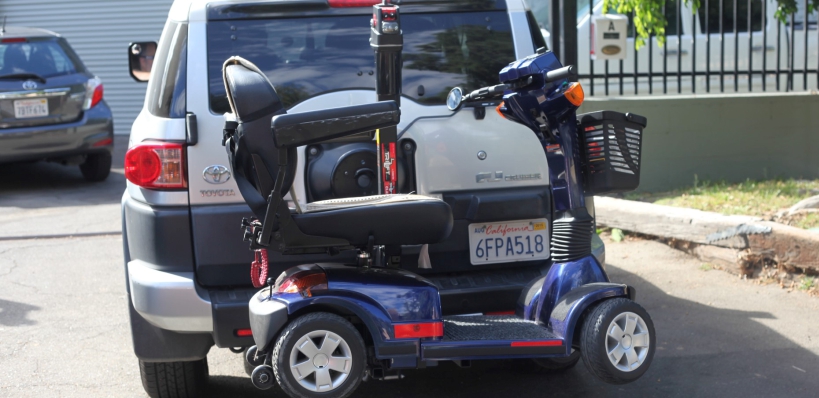
TriLift is a powered, hitch-mounted mobility-device carrier engineered to transport many scooters and power wheelchairs behind a car, SUV, truck or other compatible vehicle.
Instead of carrying the device on a large horizontal platform, the TriLift system uses two primary components: a powered lift mounted in the vehicle’s receiver hitch and a docking bracket secured to the mobility-device frame. The lift raises a triangular receiver into the corresponding triangular channel on the device bracket, creating an interlocking connection for transport.
Its compact architecture is designed to reduce rear overhang, simplify loading, eliminate routine strap handling and make removal or storage easier than many conventional platform carriers. Actual fit depends on the exact vehicle, hitch, mobility device, weight and bracket application, so every purchase should begin with a compatibility review.
Simple Everyday Operation
The patented triangular interlocking design is intended to make loading and unloading straightforward while keeping the carrier compact.
The selected TriLift assembly fits into the vehicle’s compatible receiver hitch and connects to the appropriate vehicle power wiring.
A model-specific docking bracket is bolted or clamped to the scooter or power-wheelchair frame. Many applications do not require drilling.
Lower the lift, position the mobility device so the two triangular components align, then activate the switch to raise and engage the bracket.
The docking geometry wedges into the lock area as the device reaches the raised travel position. Confirm secure engagement before driving.
TriLift Models and Specifications
TriLift publishes four standard models. Capacity must be selected using the actual travel-ready weight of the scooter or power chair, including batteries and installed accessories.
| Model | Complete Lift Weight | Lift Height | Rear “Back Space” | Rated Loading Capacity | Published Cycle Load Time |
|---|---|---|---|---|---|
| T4011 UltraLite | 60 lb | 65 in. | 12 in. | 160 lb | 40 seconds |
| T4021 Classic | 75 lb | 65 in. | 12 in. | 240 lb | 40 seconds |
| T1030 Heavy Duty | 100 lb | 65 in. | 13 in. | 350 lb | 1 minute 20 seconds |
| T1040 Super Heavy Duty | 100 lb | 65 in. | 13 in. | 450 lb | 2 minutes 40 seconds |
Specifications are based on TriLift Mobility’s published product overview and should be reconfirmed for the current production model before ordering.
Vehicle + Hitch + Mobility Device
Confirm year, make, model, rear structure, available hitch, tongue-weight limits, suspension, ground clearance, bumper clearance, backup sensors, cameras and exhaust location.
Document the exact manufacturer, model, frame design, wheelbase and complete loaded weight. The docking bracket must securely match the scooter or power-chair frame.
TriLift notes Class 2 requirements for the UltraLite and Class 3 requirements for standard/heavier applications, plus suitable auxiliary power wiring or an available 7-way connection.
TriLift’s FAQ recommends a 2-inch by 2-inch Class 3 hitch for its heavy-duty lifts and suggests an approximate hitch height of 15 to 17 inches from the ground to the bottom of the receiver for optimal performance. The final requirement is model- and vehicle-specific.
Never select a lift solely by scooter weight. The vehicle, hitch, electrical system, bracket, clearance and manufacturer ratings must work together.
TriLift vs. Traditional Platform Carriers
| Consideration | TriLift-Style Docking Carrier | Traditional Platform Carrier |
|---|---|---|
| Rear footprint | Compact, narrow profile with limited back space. | Large platform may extend farther behind the vehicle. |
| Loading routine | Align the docking bracket and use powered raise/lower control. | May require unfolding, driving onto a platform and applying straps or securement devices. |
| Securement | Triangular interlocking docking mechanism. | Commonly uses straps, clamps or integrated hold-downs. |
| Lift weight | Published complete weights range from 60 to 100 lb. | Often heavier because of the platform structure. |
| Storage | Smaller assembly may be easier to remove and store. | Bulky platform can require more storage room and handling. |
| Device flexibility | Requires the correct frame-mounted docking bracket. | Platform dimensions and securement determine fit. |
Neither design is automatically right for every person. A platform can be useful when a household changes devices frequently or cannot attach an appropriate docking bracket. TriLift can be especially appealing when the customer values compactness, fewer loading steps, reduced carrier weight and a cleaner appearance behind the vehicle.
Features, Accessories and Ownership
TriLift states that a tilt option is available for many SUVs, vans and trucks to help with rear-door or hatch access. Confirm clearance with the actual vehicle.
A 7-pin lift-end option may simplify the electrical connection on compatible vehicles. Verify continuous auxiliary power, connector wiring and fuse protection.
Brackets are not universally interchangeable. Some mobility devices share frames, but each application must be confirmed before moving a lift between chairs or scooters.
TriLift publishes documentation for a wireless remote-control option. Ask which control configuration is included and what backup operation is available.
The compact lift geometry may provide more clearance than many platform systems, but garage-door height, driveway slope and loaded-device height must be measured.
Regularly inspect the hitch pin, receiver, wiring, power cable, docking bracket, fasteners, welds, moving components and locking engagement. Follow the current owner’s manual.
Professional Selection Matters
Vehicle lifts combine mobility equipment, automotive towing hardware, electrical wiring and safe load management. Electropedic can help organize the information needed to determine whether a TriLift is appropriate for your vehicle and scooter or power wheelchair.
Our Burbank location serves customers throughout Burbank, Glendale, North Hollywood, Studio City, Toluca Lake, the San Fernando Valley and the greater Los Angeles area. Bring the mobility device—or provide the exact model and weight—so the lift capacity and bracket application can be reviewed accurately.
TriLift Mobility Questions
The normal TriLift concept uses its triangular docking and locking mechanism rather than the routine tie-down straps associated with many platform carriers. Always operate the lift according to the current manufacturer instructions.
TriLift promotes broad compatibility, but no purchase should be treated as universal without verification. The exact device frame, weight, bracket, vehicle, hitch and clearances must be checked.
TriLift’s published FAQ states that a 2-inch by 2-inch Class 3 hitch is recommended for heavy-duty lifts. It also identifies Class 2 for the UltraLite and Class 3 for standard TriLift applications. Vehicle and hitch ratings remain controlling.
TriLift recommends approximately 15 to 17 inches from the ground to the bottom of the receiver for optimal performance. Adapters or application-specific parts may be needed, subject to safe ratings and manufacturer guidance.
A tilt option is available for many SUVs, vans and trucks, according to TriLift. Actual access depends on the vehicle, mobility device, bracket and lift configuration.
TriLift states that brackets typically attach to the mobility-device frame with U-bolts or U-clamps and that many applications require no drilling. The correct approved attachment method varies by model.
The compact lift can be removable, but the second vehicle must have compatible hitch and power provisions. Vehicle-specific geometry, adapters and ratings must be verified before use.
Start with the full device weight, then evaluate vehicle and hitch ratings, receiver height, bracket fit, electrical requirements and needed rear clearance. Call Electropedic in Burbank at 800-727-1954 for assistance gathering the correct information.
Visit Electropedic
907 N. Hollywood Way
Burbank, CA 91505
Phone: 800-727-1954
Call before visiting to discuss current TriLift information, compatibility details, showroom availability, ordering and installation needs.